
One World, Two Ways In: Building the Nafuna Avenues Series and Game
A musical mobile game and an animated series, built from the same world. How Moho and Blender divide the labour — and why our animation is neither purely rigged nor purely drawn.
There is a version of this project where we build the game first, ship it, and then figure out the series. There is another version where we build the series and hope someone wants to play in it later.
We are not building either of those.
We are building one world with two doors. Nafuna Avenues — a musical mobile game and an animated series, made from the same characters, the same assets, the same animation files. You can watch it or you can play it, and both are the real thing.
That decision shapes everything downstream. This is how the pipeline actually works.

The characters live in Moho
Every recurring character in Avenues starts life as vector artwork in Moho and gets animated there. Khetiwe, Angry Mwana — 2D characters with bones, not 3D models.
That is a deliberate choice. 2D gives us the thing that matters most for a series built on character: expression. A raised eyebrow, a mouth that arrives half a frame late, hair that swings after the head has already turned. Those are the frames an audience actually remembers, and they are far easier to draw than to simulate.
The animation is neither purely rigged nor purely drawn
This is the part most people get wrong about our process, so it is worth being precise.
We do not choose between rigging and frame-by-frame animation. We use both, in sequence, on the same shot.
First pass: the rig. The character is built as a layer hierarchy — arms, forearms, head, body, props — bound to a bone rig. We block the major poses and let inverse kinematics solve the relationships between joints. This gets us timing and arcs fast, which is most of what makes an animation read. It is ugly and disposable on purpose.
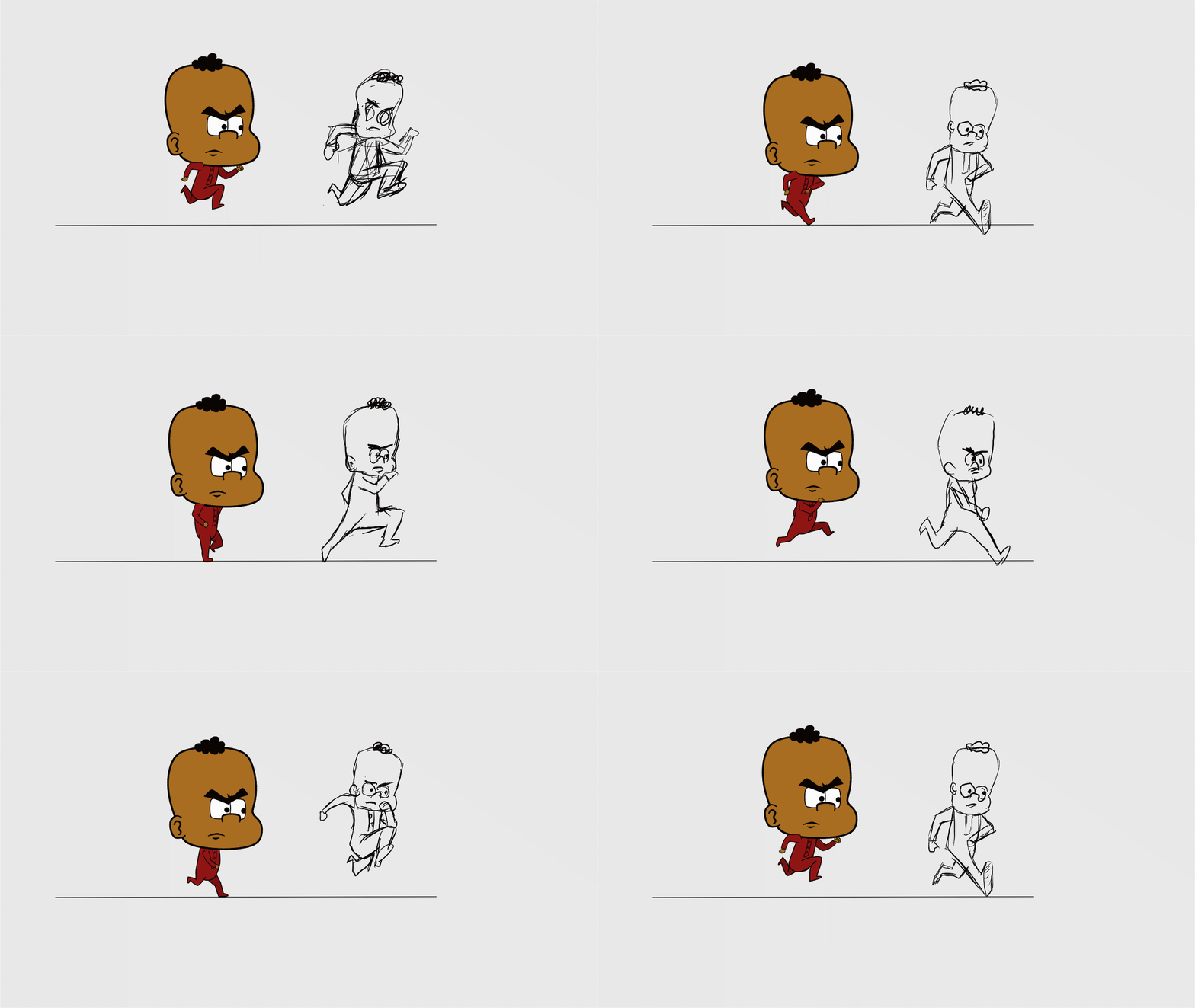
Second pass: the hand. With the motion correct but lifeless, we switch on onion skins and start drawing over the rig — new frames, refinement, correction. This is where personality enters:
- Pops and snaps — interpolation is smooth by default, and drama is not smooth
- Expressions — blinks, subtle mouth shapes, the flicker of a thought
- Secondary action — hair ties, cloth, follow-through that the rig has no opinion about
- Squash and stretch — the physics of appeal
The rig solves relationships. The hand solves intention.
That balance shifts per character. Khetiwe leans more on the rig, refined at the beats that matter. Angry Mwana's run cycle leans hard into frame-by-frame, because that particular energy — the bounce, the weight, the snap — is drawn, not solved.

For the full technique — the layer stack, and when to lean on the rig versus the drawing pass — see Rig to Move, Draw to Live.
The world lives in Blender
Moho gives us characters. Blender gives us the places they exist in.
The same character animation needs to serve two very different destinations: a game, where a player drives the character and timing changes constantly, and a series, where every frame is authored and fixed. Blender is where those two outputs are reconciled — environments, camera, lighting, effects, and the game itself.
The important part is not the specific handoff. It is that we designed the animation to survive both from the beginning — clean layers, clean naming, character rigs built to be re-posed rather than baked into one performance.
Why two pieces of software instead of one
Because each is genuinely better at its half, and the alternative costs more than it saves.
You can do 2D character animation in Blender. You can build a game in a 2D animation tool. In both cases you are fighting the tool for months to get something a purpose-built tool does natively — and you are training your team to be mediocre at two jobs instead of excellent at one.
Moho is exceptional at 2D character performance and vector workflow. Blender is exceptional at 3D environment, rendering and real-time. The seam between them is a file format, not a compromise.
What this means beyond us
Here is the uncomfortable truth about African animation: there is enormous talent and almost no pipeline. Most studios can make a beautiful short. Very few can produce twenty episodes and a playable game from the same universe, because that is an infrastructure problem, not an art problem.
We are solving it in public, with tools anyone can download for free or for a few hundred dollars. Moho. Blender. A laptop. No render farm, no five-figure software licences, no foreign studio to subcontract the hard parts to.
That is what Culture × Technology means to us — not a slogan on a poster, but an actual production decision: that African stories should be able to reach world-class technical quality using tools we can own and skills we can teach.
Nafuna Avenues is where that gets tested.
Nafuna Africa builds animation, games and digital media for African brands, institutions and stories — and trains the next generation to make them through Nafuna Campus. If you have a story that needs to move, start with a free brand roadmap, or book a discovery call.
Your story deserves to be heard.
Turn your complex ideas into captivating, culturally authentic campaigns and automated creative workflows.